 Add to Chrome
 Add to Firefox
 Add to Edge
Personalized Cross-Modal Emotional Correlation Learning for Speech-Preserving Facial Expression Manipulation
Apr 28, 2026
Speech-preserving facial expression manipulation (SPFEM) aims to enhance human expressiveness without altering mouth movements tied to the original speech. A primary challenge in this domain is the scarcity of paired data, namely aligned frames of the same individual with identical speech but different expressions, which impedes direct supervision for emotional manipulation. While current Visual-Language Models (VLMs) can extract aligned visual and semantic features, making them a promising source of supervision, their direct application is limited. To this end, we propose a Personalized Cross-Modal Emotional Correlation Learning (PCMECL) algorithm that refines VLM-based supervision through two major improvements. First, standard VLMs rely on a single generic prompt for each emotion, failing to capture expressive variations among individuals. PCMECL addresses this limitation by conditioning on individual visual information to learn personalized prompts, thereby establishing more fine-grained visual-semantic correlations. Second, even with personalization, inherent discrepancies persist between the visual and semantic feature distributions. To bridge this modality gap, PCMECL employs feature differencing to correlate the modalities, providing more precisely aligned supervision by matching the change in visual features to the change in semantic features. As a plug-and-play module, PCMECL can be seamlessly integrated into existing SPFEM models. Extensive experiments across various datasets demonstrate the superior efficacy of our algorithm.

Learning Spatial-Temporal Coherent Correlations for Speech-Preserving Facial Expression Manipulation
Apr 22, 2026Speech-preserving facial expression manipulation (SPFEM) aims to modify facial emotions while meticulously maintaining the mouth animation associated with spoken content. Current works depend on inaccessible paired training samples for the person, where two aligned frames exhibit the same speech content yet differ in emotional expression, limiting the SPFEM applications in real-world scenarios. In this work, we discover that speakers who convey the same content with different emotions exhibit highly correlated local facial animations in both spatial and temporal spaces, providing valuable supervision for SPFEM. To capitalize on this insight, we propose a novel spatial-temporal coherent correlation learning (STCCL) algorithm, which models the aforementioned correlations as explicit metrics and integrates the metrics to supervise manipulating facial expression and meanwhile better preserving the facial animation of spoken content. To this end, it first learns a spatial coherent correlation metric, ensuring that the visual correlations of adjacent local regions within an image linked to a specific emotion closely resemble those of corresponding regions in an image linked to a different emotion. Simultaneously, it develops a temporal coherent correlation metric, ensuring that the visual correlations of specific regions across adjacent image frames associated with one emotion are similar to those in the corresponding regions of frames associated with another emotion. Recognizing that visual correlations are not uniform across all regions, we have also crafted a correlation-aware adaptive strategy that prioritizes regions that present greater challenges. During SPFEM model training, we construct the spatial-temporal coherent correlation metric between corresponding local regions of the input and output image frames as an additional loss to supervise the generation process.
Robotic Manipulation is Vision-to-Geometry Mapping ($f(v) \rightarrow G$): Vision-Geometry Backbones over Language and Video Models
Apr 14, 2026At its core, robotic manipulation is a problem of vision-to-geometry mapping ($f(v) \rightarrow G$). Physical actions are fundamentally defined by geometric properties like 3D positions and spatial relationships. Consequently, we argue that the foundation for generalizable robotic control should be a vision-geometry backbone, rather than the widely adopted vision-language or video models. Conventional VLA and video-predictive models rely on backbones pretrained on large-scale 2D image-text or temporal pixel data. While effective, their representations are largely shaped by semantic concepts or 2D priors, which do not intrinsically align with the precise 3D geometric nature required for physical manipulation. Driven by this insight, we propose the Vision-Geometry-Action (VGA) model, which directly conditions action generation on pretrained native 3D representations. Specifically, VGA replaces conventional language or video backbones with a pretrained 3D world model, establishing a seamless vision-to-geometry mapping that translates visual inputs directly into physical actions. To further enhance geometric consistency, we introduce a Progressive Volumetric Modulation module and adopt a joint training strategy. Extensive experiments validate the effectiveness of our approach. In simulation benchmarks, VGA outperforms top-tier VLA baselines including $π_{0.5}$ and GeoVLA, demonstrating its superiority in precise manipulation. More importantly, VGA exhibits remarkable zero-shot generalization to unseen viewpoints in real-world deployments, consistently outperforming $π_{0.5}$. These results highlight that operating on native 3D representations-rather than translating through language or 2D video priors-is a highly promising direction for achieving generalizable physical intelligence.
Learning Hierarchical and Geometry-Aware Graph Representations for Text-to-CAD
Apr 11, 2026Text-to-CAD code generation is a long-horizon task that translates textual instructions into long sequences of interdependent operations. Existing methods typically decode text directly into executable code (e.g., bpy) without explicitly modeling assembly hierarchy or geometric constraints, which enlarges the search space, accumulates local errors, and often causes cascading failures in complex assemblies. To address this issue, we propose a hierarchical and geometry-aware graph as an intermediate representation. The graph models multi-level parts and components as nodes and encodes explicit geometric constraints as edges. Instead of mapping text directly to code, our framework first predicts structure and constraints, then conditions action sequencing and code generation, thereby improving geometric fidelity and constraint satisfaction. We further introduce a structure-aware progressive curriculum learning strategy that constructs graded tasks through controlled structural edits, explores the model's capability boundary, and synthesizes boundary examples for iterative training. In addition, we build a 12K dataset with instructions, decomposition graphs, action sequences, and bpy code, together with graph- and constraint-oriented evaluation metrics. Extensive experiments show that our method consistently outperforms existing approaches in both geometric fidelity and accurate satisfaction of geometric constraints.
RADAR: Benchmarking Vision-Language-Action Generalization via Real-World Dynamics, Spatial-Physical Intelligence, and Autonomous Evaluation
Feb 11, 2026VLA models have achieved remarkable progress in embodied intelligence; however, their evaluation remains largely confined to simulations or highly constrained real-world settings. This mismatch creates a substantial reality gap, where strong benchmark performance often masks poor generalization in diverse physical environments. We identify three systemic shortcomings in current benchmarking practices that hinder fair and reliable model comparison. (1) Existing benchmarks fail to model real-world dynamics, overlooking critical factors such as dynamic object configurations, robot initial states, lighting changes, and sensor noise. (2) Current protocols neglect spatial--physical intelligence, reducing evaluation to rote manipulation tasks that do not probe geometric reasoning. (3) The field lacks scalable fully autonomous evaluation, instead relying on simplistic 2D metrics that miss 3D spatial structure or on human-in-the-loop systems that are costly, biased, and unscalable. To address these limitations, we introduce RADAR (Real-world Autonomous Dynamics And Reasoning), a benchmark designed to systematically evaluate VLA generalization under realistic conditions. RADAR integrates three core components: (1) a principled suite of physical dynamics; (2) dedicated tasks that explicitly test spatial reasoning and physical understanding; and (3) a fully autonomous evaluation pipeline based on 3D metrics, eliminating the need for human supervision. We apply RADAR to audit multiple state-of-the-art VLA models and uncover severe fragility beneath their apparent competence. Performance drops precipitously under modest physical dynamics, with the expectation of 3D IoU declining from 0.261 to 0.068 under sensor noise. Moreover, models exhibit limited spatial reasoning capability. These findings position RADAR as a necessary bench toward reliable and generalizable real-world evaluation of VLA models.
Neural Clothing Tryer: Customized Virtual Try-On via Semantic Enhancement and Controlling Diffusion Model
Jan 30, 2026This work aims to address a novel Customized Virtual Try-ON (Cu-VTON) task, enabling the superimposition of a specified garment onto a model that can be customized in terms of appearance, posture, and additional attributes. Compared with traditional VTON task, it enables users to tailor digital avatars to their individual preferences, thereby enhancing the virtual fitting experience with greater flexibility and engagement. To address this task, we introduce a Neural Clothing Tryer (NCT) framework, which exploits the advanced diffusion models equipped with semantic enhancement and controlling modules to better preserve semantic characterization and textural details of the garment and meanwhile facilitating the flexible editing of the model's postures and appearances. Specifically, NCT introduces a semantic-enhanced module to take semantic descriptions of garments and utilizes a visual-language encoder to learn aligned features across modalities. The aligned features are served as condition input to the diffusion model to enhance the preservation of the garment's semantics. Then, a semantic controlling module is designed to take the garment image, tailored posture image, and semantic description as input to maintain garment details while simultaneously editing model postures, expressions, and various attributes. Extensive experiments on the open available benchmark demonstrate the superior performance of the proposed NCT framework.
Exploring Talking Head Models With Adjacent Frame Prior for Speech-Preserving Facial Expression Manipulation
Jan 19, 2026Speech-Preserving Facial Expression Manipulation (SPFEM) is an innovative technique aimed at altering facial expressions in images and videos while retaining the original mouth movements. Despite advancements, SPFEM still struggles with accurate lip synchronization due to the complex interplay between facial expressions and mouth shapes. Capitalizing on the advanced capabilities of audio-driven talking head generation (AD-THG) models in synthesizing precise lip movements, our research introduces a novel integration of these models with SPFEM. We present a new framework, Talking Head Facial Expression Manipulation (THFEM), which utilizes AD-THG models to generate frames with accurately synchronized lip movements from audio inputs and SPFEM-altered images. However, increasing the number of frames generated by AD-THG models tends to compromise the realism and expression fidelity of the images. To counter this, we develop an adjacent frame learning strategy that finetunes AD-THG models to predict sequences of consecutive frames. This strategy enables the models to incorporate information from neighboring frames, significantly improving image quality during testing. Our extensive experimental evaluations demonstrate that this framework effectively preserves mouth shapes during expression manipulations, highlighting the substantial benefits of integrating AD-THG with SPFEM.
Geometry-Editable and Appearance-Preserving Object Compositon
May 27, 2025General object composition (GOC) aims to seamlessly integrate a target object into a background scene with desired geometric properties, while simultaneously preserving its fine-grained appearance details. Recent approaches derive semantic embeddings and integrate them into advanced diffusion models to enable geometry-editable generation. However, these highly compact embeddings encode only high-level semantic cues and inevitably discard fine-grained appearance details. We introduce a Disentangled Geometry-editable and Appearance-preserving Diffusion (DGAD) model that first leverages semantic embeddings to implicitly capture the desired geometric transformations and then employs a cross-attention retrieval mechanism to align fine-grained appearance features with the geometry-edited representation, facilitating both precise geometry editing and faithful appearance preservation in object composition. Specifically, DGAD builds on CLIP/DINO-derived and reference networks to extract semantic embeddings and appearance-preserving representations, which are then seamlessly integrated into the encoding and decoding pipelines in a disentangled manner. We first integrate the semantic embeddings into pre-trained diffusion models that exhibit strong spatial reasoning capabilities to implicitly capture object geometry, thereby facilitating flexible object manipulation and ensuring effective editability. Then, we design a dense cross-attention mechanism that leverages the implicitly learned object geometry to retrieve and spatially align appearance features with their corresponding regions, ensuring faithful appearance consistency. Extensive experiments on public benchmarks demonstrate the effectiveness of the proposed DGAD framework.
ReplayCAD: Generative Diffusion Replay for Continual Anomaly Detection
May 10, 2025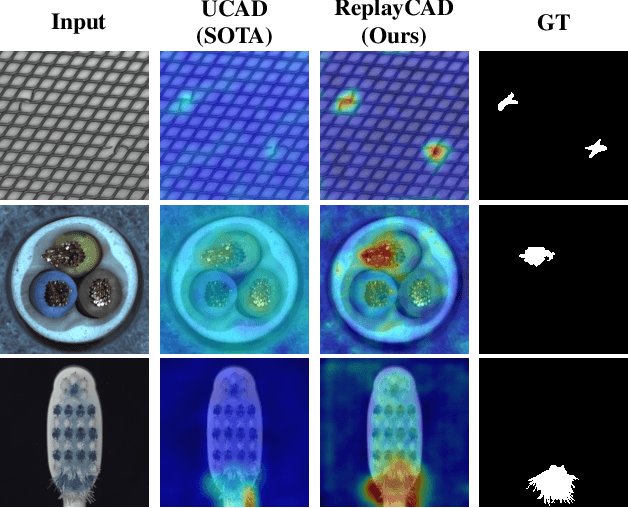
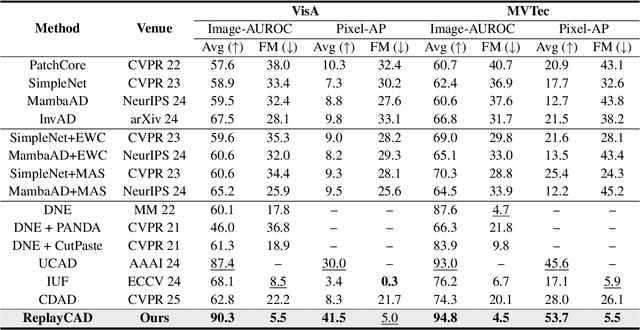
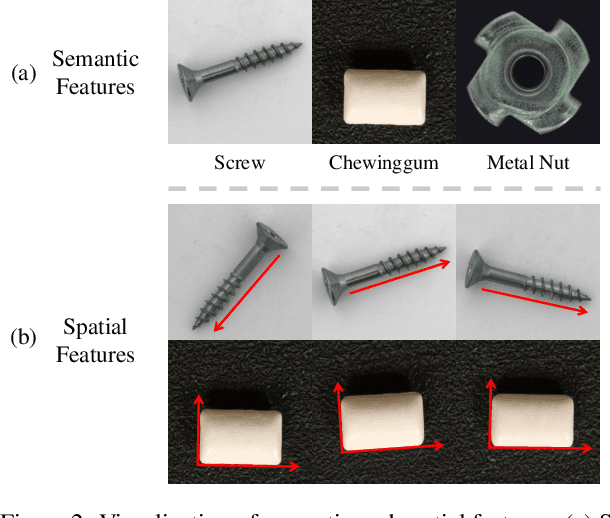
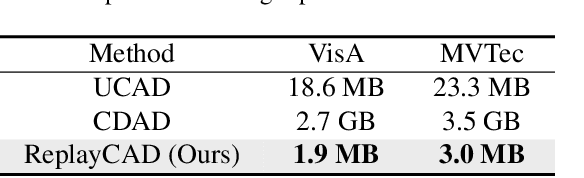
Continual Anomaly Detection (CAD) enables anomaly detection models in learning new classes while preserving knowledge of historical classes. CAD faces two key challenges: catastrophic forgetting and segmentation of small anomalous regions. Existing CAD methods store image distributions or patch features to mitigate catastrophic forgetting, but they fail to preserve pixel-level detailed features for accurate segmentation. To overcome this limitation, we propose ReplayCAD, a novel diffusion-driven generative replay framework that replay high-quality historical data, thus effectively preserving pixel-level detailed features. Specifically, we compress historical data by searching for a class semantic embedding in the conditional space of the pre-trained diffusion model, which can guide the model to replay data with fine-grained pixel details, thus improving the segmentation performance. However, relying solely on semantic features results in limited spatial diversity. Hence, we further use spatial features to guide data compression, achieving precise control of sample space, thereby generating more diverse data. Our method achieves state-of-the-art performance in both classification and segmentation, with notable improvements in segmentation: 11.5% on VisA and 8.1% on MVTec. Our source code is available at https://github.com/HULEI7/ReplayCAD.
Contrastive Decoupled Representation Learning and Regularization for Speech-Preserving Facial Expression Manipulation
Apr 08, 2025Speech-preserving facial expression manipulation (SPFEM) aims to modify a talking head to display a specific reference emotion while preserving the mouth animation of source spoken contents. Thus, emotion and content information existing in reference and source inputs can provide direct and accurate supervision signals for SPFEM models. However, the intrinsic intertwining of these elements during the talking process poses challenges to their effectiveness as supervisory signals. In this work, we propose to learn content and emotion priors as guidance augmented with contrastive learning to learn decoupled content and emotion representation via an innovative Contrastive Decoupled Representation Learning (CDRL) algorithm. Specifically, a Contrastive Content Representation Learning (CCRL) module is designed to learn audio feature, which primarily contains content information, as content priors to guide learning content representation from the source input. Meanwhile, a Contrastive Emotion Representation Learning (CERL) module is proposed to make use of a pre-trained visual-language model to learn emotion prior, which is then used to guide learning emotion representation from the reference input. We further introduce emotion-aware and emotion-augmented contrastive learning to train CCRL and CERL modules, respectively, ensuring learning emotion-independent content representation and content-independent emotion representation. During SPFEM model training, the decoupled content and emotion representations are used to supervise the generation process, ensuring more accurate emotion manipulation together with audio-lip synchronization. Extensive experiments and evaluations on various benchmarks show the effectiveness of the proposed algorithm.